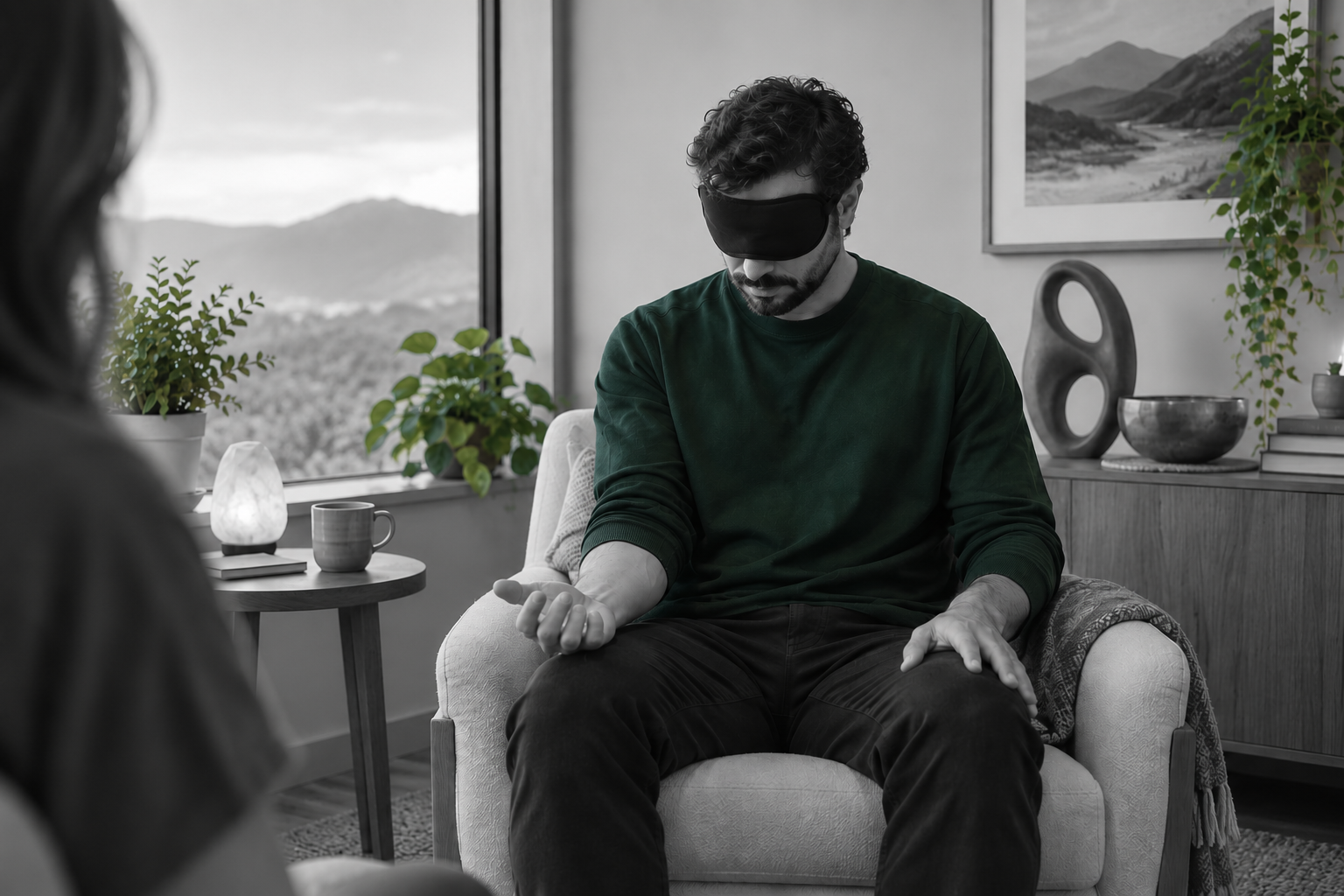
Beyond Talk: Work With What Your Primary Consciousness Is Holding
Sometimes you understand exactly why you feel the way you do—and still can’t seem to change it.
You know the relationship is safe, but your body braces for rejection. You know the stressful event is over, but part of you remains on high alert. You’ve talked about the past, made connections and gained insight, yet something underneath it all still feels stuck.
Psychedelic Somatic Interactional Psychotherapy (PSIP) is a body-based, experiential form of psychotherapy designed to work with these deeper patterns. Rather than relying only on insight or talking about what happened, PSIP helps us pay attention to what your body and nervous system may still be experiencing in the present.
What Is PSIP?
Psychedelic Somatic Interactional Psychotherapy—usually shortened to PSIP—is an experiential, bottom-up approach to psychotherapy developed for working with trauma and attachment wounds held in the form of visceral nervous system patterns. Despite the word psychedelic in its name, PSIP can be practiced with or without psychedelic medicine (assessed and prescribed by licensed medical professionals). PSIP brings together three important elements: somatic psychotherapy, nervous system work and the therapeutic relationship.
Somatic Psychotherapy
Instead of working only with thoughts, explanations and stories, somatic psychotherapy pays attention to what is happening in your body. You may notice tension or pressure, changes in temperature or breathing, trembling, numbness, impulses to move, emotions or other sensations.
These experiences can give us another way of understanding what is happening beneath the thinking mind. Rather than immediately analyzing or trying to change them, PSIP invites us to become curious about what your body is communicating.
Nervous System Work
When something once felt overwhelming, frightening or unsafe, your nervous system may have learned ways of protecting you. You might become hyper-alert, disconnect from emotion, shut down, people-please, try to stay in control, avoid certain experiences or continually prepare for the worst.
These responses can make sense when we understand them as strategies your system developed to help you navigate difficult circumstances. The challenge is that even when your thinking mind understands that the danger has passed, your nervous system may continue following an older map.
PSIP works directly with this map, including patterns of activation and protective responses such as fight, flight, freeze and dissociation (Learn more about the 4 PSIP-informed states within the nervous system). Instead of asking your thinking mind to override these responses, we become curious about what is happening underneath them and what your nervous system may still be trying to protect you from.
Relationship
Your therapist isn't simply observing your experience from across the room. PSIP is interactional, meaning the therapeutic relationship becomes an active part of the work. Your therapist stays present and engaged as difficult sensations, emotions and relational patterns emerge, creating an opportunity to experience support and connection while navigating something that may previously have felt overwhelming.
PSIP can also work with both positive and negative transference—the feelings, expectations and relational patterns that arise toward your therapist—as a pathway for exploring attachment wounds. When some of our deepest protective patterns were formed in relationship, the therapeutic relationship can become a place where those patterns are experienced, understood and worked with in real time.

How Does PSIP Work?
PSIP is different from psychotherapy that primarily involves talking about what happened. One of the ideas that helps explain this difference comes from the distinction between primary and secondary consciousness described within theories of consciousness and psychedelic research, including Dr. Robin Carhart-Harris's Entropic Brain Hypothesis.
Put simply, there can be a difference between knowing something intellectually and experiencing it differently internally.
Primary Consciousness
Primary consciousness refers to a more immediate way of experiencing ourselves and the world. It includes sensory experience, emotion and what is unfolding internally in the present moment. Rather than thinking about an emotion, you are experiencing its felt sense.
You might notice tightness building in your chest, warmth moving through your body, trembling in your hands, an impulse to pull away or an emotion emerging before you can name it. Primary consciousness brings us closer to the direct experience underneath our explanations and interpretations.
In simple terms, primary consciousness feels and experiences.
Secondary Consciousness
Secondary consciousness refers to a more advanced, self-reflective form of awareness. It allows us to think about our experiences, name emotions, make meaning, connect the remembered past with an anticipated future and understand ourselves across time.
Secondary consciousness allows you to say, “I'm anxious,” “I react this way because of what happened to me,” or “I know this situation is different from what happened in the past.” It gives us the ability to understand and organize our experiences intellectually.
In simple terms, secondary consciousness knows and understands.

Both forms of consciousness are important. But sometimes we can become very good at understanding something without that understanding changing how we experience it internally. You might know that you're safe while your body remains tense and vigilant. You might understand why you fear abandonment while still feeling panic when someone pulls away. You may know you don't need to be perfect while your body still responds to a mistake with a wave of shame.
PSIP is interested in this space between what you intellectually know and what your body continues to experience.
During experiential PSIP work, your therapist may invite you to notice what is happening inside your body while intentionally limiting some of the usual strategies we use to move away from uncomfortable internal experiences. These managing strategies might include analyzing, explaining, distracting, controlling, intellectualizing or disconnecting.
As we gently hold back some of these familiar strategies, experiences underneath them may become more noticeable. You might become aware of sensory changes in the body, shaking or trembling, numbness, impulses to move, emotions, memories, images or shifts in how you experience your therapist.
There isn't a particular response you're supposed to have, and the goal isn't to force an emotional release or manufacture a breakthrough. Instead, we create the conditions for your system to safely explore experiences it may previously have needed to avoid, suppress or disconnect from.
Who Might PSIP Be Helpful For?
PSIP may be worth exploring if you feel as though you understand your patterns intellectually but haven't been able to fully shift them. You may have already spent considerable time reflecting on your past, understanding why certain patterns developed or even participating in psychotherapy, yet still have the sense that something deeper hasn't changed. PSIP may be considered when working with experiences such as:
PTSD or complex PTSD
Developmental or attachment trauma
Emotional shutdown or dissociation
Difficulty trusting or feeling safe with others
Persistent relational or attachment patterns
Feeling disconnected from emotions or bodily experience
A sense that something remains “stuck,” even after gaining significant insight
PSIP isn't automatically the right fit for everyone. Your history, current mental health stability, physical health, goals, therapy experience, supports circles and readiness all matter.
What Does Getting Started With PSIP Look Like?
PSIP is a gradual process. We don't begin with psychedelic-assisted experiential work. Instead, there are several steps designed to help you understand the approach, determine whether it feels like a good fit and prepare your nervous system and therapeutic relationship for the work.
1. Learn About PSIP
Before considering PSIP, we ask you to watch an introductory video on trauma, autonomic system and dissociation (watch video) and read this article about the approach. We want you to have a clear understanding of what PSIP involves, why we use it and what the experience may be like before deciding whether you would like to explore it further.
2. Set Up a Consultation With Sara
The next step is a consultation call with Sara to discuss your interest in PSIP and whether it may be suitable for what you're hoping to work on. This is also an opportunity to ask questions, talk through any concerns and get a better sense of what the process would look like for you. Please note, there’s currently a waitlist for PSIP.
3. Begin With Intake and Non-Medicine PSIP
If you decide to move forward, we'll begin with an intake session and PSIP psychotherapy without medicine. We'll spend time understanding your history, current concerns, coping strategies, relationship patterns and what you hope will change.
This stage also helps you develop greater awareness of your nervous system and practise sensing, tracking and following your body's felt experience. You may begin noticing how activation shows up, what happens before you disconnect, where emotions appear in your body and which strategies you instinctively use when something becomes uncomfortable. In many ways, we're learning the language your nervous system already speaks.
PSIP also relies heavily on the relationship between you and your therapist, so connection isn't something we rush past to get to the “real work.” Developing trust, noticing what happens between us and becoming comfortable with the experiential process are all part of preparing for deeper PSIP work.
4. Consider Psychedelic-Assisted PSIP
Psychedelic medicine isn't required for PSIP. If, after your intake and non-medicine PSIP sessions, you and your therapist collaboratively decide that psychedelic-assisted PSIP may be an appropriate next step, you'll be connected with medical provider for a separate medical assessment.
During this assessment, you can discuss whether psychedelic medicine may be appropriate for you, along with relevant health considerations, medications, potential risks and contraindications. Medical clearance is required before moving forward with psychedelic-assisted PSIP. Please note, at A Time To Heal, PSIP therapy only works with legal and medically-assessed and prescribed psychedelic medicines.
5. Begin Psychedelic-Assisted PSIP Sessions
Once you've received medical assessment and, you and your therapist agree that you're ready to proceed, further PSIP sessions can begin. These are more intensive experiential sessions and typically last approximately two hours.
Your therapist remains actively engaged with you throughout the session, helping you notice and follow bodily sensations, emotions, nervous system responses and relational experiences as they emerge. Each PSIP session is followed by an integration session, where we make space to process what happened, understand what may have emerged and explore how the experience connects with your life outside of therapy.
Is PSIP Safe?
Safety is an essential part of PSIP. Because this work combines intensive experiential psychotherapy with psychedelic medicine, we follow a structured safety protocol before, during and after each sessions.
Before moving forward, you'll need to complete a medical assessment with a licensed medical provider. This assessment helps determine whether the psychedelic medicine being considered is appropriate for you and provides an opportunity to review your health history, medications, possible contraindications and other relevant safety considerations.
There are also a number of other practical safety requirements surrounding psychedelic-assisted therapy sessions. We'll review the full safety protocol with you before your first PSIP session so that you understand what to expect, how to prepare and what will be required afterward. Medical clearance is an important part of this process, but so are psychological readiness, preparation and the ongoing clinical judgment of you and your therapist.

Can PSIP Feel Intense?
It can. PSIP may bring you into contact with emotions, sensations or nervous system states that you would normally move away from—and there may have been very good reasons your system learned to do that.
Protective strategies such as shutting down, disconnecting, analyzing, controlling or avoiding didn't appear for no reason. At some point, they may have helped you manage experiences that felt too overwhelming, unpredictable or unsafe to fully experience. PSIP isn't about deciding those strategies are bad or trying to strip them away.
It also isn't a therapy about pushing through discomfort at all costs. Readiness, trust, pacing and integration matter. The goal is to create enough support and safety to become curious about what lies underneath familiar protective patterns without forcing your system somewhere it isn't ready to go.
Sometimes meaningful work asks us to approach places we've spent years avoiding. We don't have to charge toward them. We can approach them together.
Important: What We Don’t Do!
At our clinic, we embody an evidence-informed, medically-responsible and safety-first stance towards psychedelics. We are not gate keepers, nor underground psychedelic trip sitters. We do not provide or administer illegal psychedelic substances in therapy, and we do not offer information on where to access or buy controlled substances. We cannot recommend, promote or advise regarding non-prescribed and non-legal psychedelic use.
The research indicates that when used safely, with adequate preparation and for certain mental health challenges, psychedelics can be transformative. However, we are in an era, when TV shows, social media and news articles are characterizing mind altering substances as quick fixes for anxiety, depression and trauma. This depiction is both unrealistic and irresponsible. Best-practice research indicates that the most helpful outcomes of psychedelics come from using them with guidance of informed therapists as well as safe and intentionally cured settings.